
The Protocol
How the GRONK Kernel splits, routes, compounds and votes — automatic, on-chain, holder-directed.
The leak nobody fixed
A memecoin is a machine for converting attention into liquidity. It works extremely well. The problem starts immediately afterwards: the liquidity arrives, and then it does nothing.
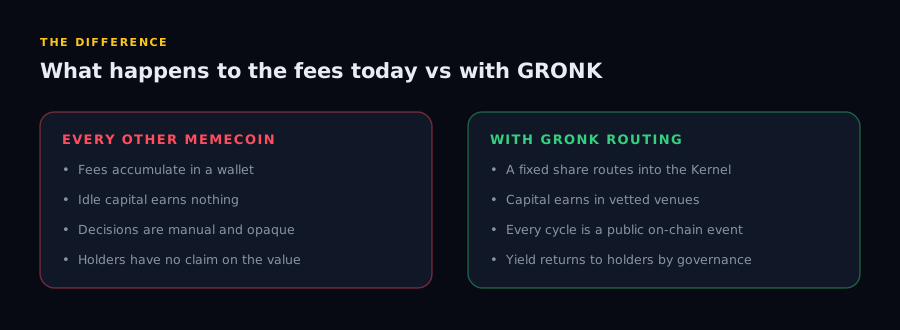
Creator fees accumulate in a wallet. Trading fees accumulate in a pool. Holders hold a token with no claim on any of the value moving through it. Every decision about what to do with that value is manual, discretionary, and unverifiable until after it has already happened.
Value isn't lost because nobody cares. It's lost because nothing is connected to it.
GRONK is the connector. It sits between the flow of trade revenue and the places that revenue can actually work, and it runs the routing automatically.
Four steps, one cycle
Every cycle — whether that's a trade settling or a scheduled claim — runs the same four steps.
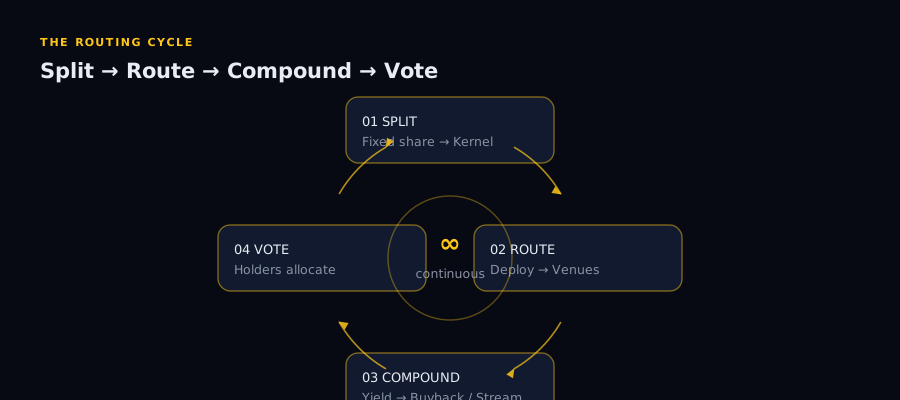
01 · Split
A fixed share of trade flow settles into the GRONK Kernel. The ratio is written into the contract at deployment. It is not adjustable by the team, by a multisig, or by any admin key. If you want a different ratio than the one you can read, the only path is a fork.
02 · Route
The kernel deploys that capital into vetted on-chain venues. At launch this means stable-pair liquidity positions and lending markets. As the registry matures it extends to tokenised treasury rails and other transparent on-chain yield sources.
03 · Compound
Yield returned from routed capital has exactly two possible destinations, both chosen by holders:
- Buyback and burn — yield buys $GRONK on the open market and destroys it, permanently reducing supply.
- Direct streaming — yield is streamed to staked holders on a fixed schedule.
The split between those two is the most consequential governance decision in the system, and it is voted on continuously.
04 · Vote
A defined portion of every cycle is allocated by holder governance, not by the founding team. Proposals are on-chain, votes are weighted by holdings, and outcomes bind without a final approval step. There is no committee with veto power over the treasury.
Who actually executes this
Routing decisions are executed by permissionless keeper nodes. Anyone can run one. A keeper's job is narrow and mechanical: read the cycle condition, submit the routing transaction, collect the keeper fee. It cannot deviate from the rule, because the rule lives in the contract and the contract rejects invalid calls.
This is what the N in GRONK stands for, and it is why no single operator can quietly redirect the flow. If the keepers stop, the system stalls — it does not get hijacked.
The kernel is deliberately small
The on-chain core is minimal on purpose. Small contracts are auditable, and an unauditable routing layer is worse than no routing layer. The kernel does four things: hold the split ratio, maintain the venue registry, execute a cycle, and expose the ledger. Everything else lives in the venues, in the governance module, or off-chain where it can be verified against the chain.
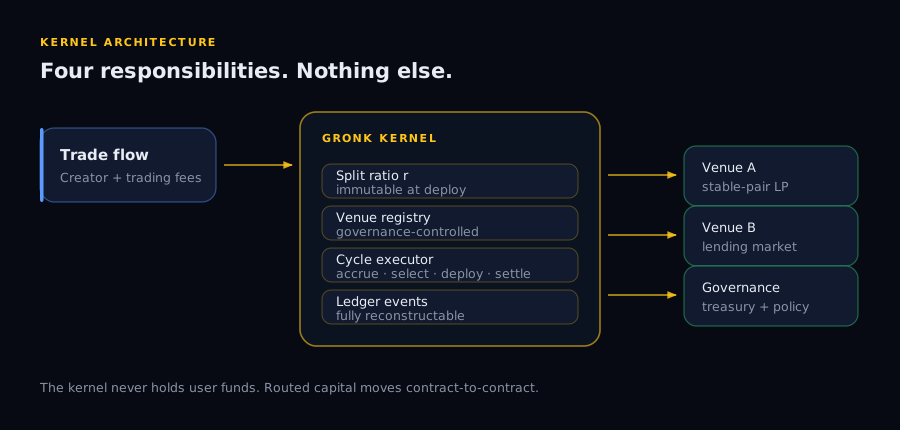
Governed, not roadmapped
Most projects describe the future on a roadmap slide and never revisit it. GRONK's mechanism changes through proposals, on-chain, with a public record of who voted for what. The roadmap on this site is a statement of intent. The governance module is the actual authority.
Route the attention. Keep the value.
Read the mechanism, then decide. No presale, no private round, no custody.